State of the Art in Electromagnetic Therapeutics Soft Tissue Applications Pilla
IEEE PULSE presents
The State of Nanorobotics in Medicine
Feature September/Oct 2019
Posted on seven Oct 2019
From Ant-Man to the Incredible Shrinking Machine, society has long envisioned developing devices tiny plenty to enter man cells. Such nanotechnology could revolutionize the diagnosis of diseases like cancer and neurodegeneration, span new methods of precise drug delivery, and even directly repair damaged organs.
Nanomaterials are already used in a host of products such as sunscreens, food, and cosmetics, but equipping these tiny particles with more active functions— the dream of nanomedicine—is still, for the most part, distant. Although researchers in academia and industry akin have pursued developing nanorobotics in medicine, shrinking any hardware runs into its fair share of problems.
The Size of the Nanoscale
A DNA molecule is 2.five nm; proteins 10 nm; virus 100 nm;
bacterium m nm; human cells 10,000 nm.
A major claiming seems unproblematic on the normal scale: movement. Merely on the nanoscale, no battery is small enough to power a nanobot. Teams across the globe are exploring different options to control nanorobotics in the body, with approaches ranging from using electromagnetic and chemical tactics, to borer into nature.
The second challenge is the body itself. To effectively perform a role, nanorobotics must evade the array of defenses the trunk employs against tiny intruders, surpassing or evading natural barriers (like the blood–encephalon barrier) and withstanding sometimes harsh environments, similar an acidic human stomach or T-cell-filled bloodstream. What'due south more, any nanomaterials used in the body would need to be evaluated for toxicity and foreclose against an unwanted immune response.
Furthermore, the science itself is still being understood. I nanometer is 100,000 times less than the diameter of a pilus and, when you shrink things down to that size, properties of materials are fundamentally dissimilar. Forces that ordinarily don't have to exist taken into account—such every bit the influence of nearby molecules—now do. Despite these challenges, the field, though nevertheless in its nascent stage, is making progress in these areas, and researchers are optimistic about the potential for nanorobotics to revolutionize targeted medicine, particularly cancer.
Nature as Inspiration
Most nanotechnology for medicine entails using small particles to acquit materials and deliver them to or within cells. Frequently this commitment happens past take chances; controlled delivery efforts, yet, aim to develop very uncomplicated robotic systems made up of a payload and trounce that can exist directed to a specific site. These devices are guided by external forces—such as electromagnetic fields—or through fabrication techniques that have advantage of chemical or biological reactions.

"The topic of nanomedicine every bit containers that can evangelize pharmaceutically active compounds in a targeted style has been effectually a long fourth dimension," says Peer Fischer, a professor of concrete chemical science at the University of Stuttgart who heads the independent Micro Nano and Molecular Systems Lab at the Max Planck Institute for Intelligent Systems in Stuttgart (Effigy one, right). "What is tough to practise, and what many groups are focusing on, is making these carriers active. For case, rather than relying on a passive improvidence process to distribute a medicine in the claret, a controlled swarm of nanoparticles could be sent to difficult-to-reach areas, like a tumor."
When it comes to generating motion, beast-forcefulness mechanics aren't a skilful approach on the nanoscale, considering it's difficult to generate that strength locally. What's more, nanorobotics aimed at entering organs like the lung, intestine, tummy, or eyes, for example, take to bargain with one of the body'south main defenses against micro-intruders: complex biological fluids like mucus.
In a one–two punch to tackle the problem of locomotion and entering through mucus, Fischer's group looked to the ulcer-causing helio pylori bacteria for inspiration, both for its corkscrew-similar shape as well every bit for its ability to discrete enzymes and disrupt the mucus. The bacteria'due south small size and shape allows it to move through soft tissues and fluids like mucus, where motions like drilling (rather than swimming) are needed to propel. This is because, as one goes smaller, what previously appeared as a homogeneous liquid distinguishes into a more "spaghetti-like" molecular mesh of macromolecules, explains Fischer. If the diameter of the propeller is small plenty, information technology can drill through the gaps in this network.
"That's how very pocket-size systems can actively move through these penetration barriers with very little forcefulness," Fischer says. "Bacterium is literally a drill."
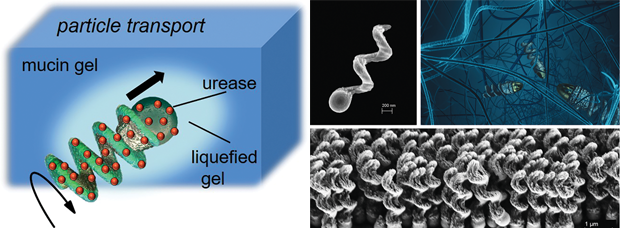
Fischer'due south grouping mimics the corkscrew shape of the pathogen past using a custom 3D fabrication manufacturing process to create small-scale propellers roughly 400 nm long (nearly xx times smaller than a human being blood cell) made out of silicon dioxide and other materials. These propellers make a similar corkscrew move through fluid and can exist controlled magnetically (Figure 2). A collaborative group led by the Max Planck Institute for Intelligent Systems reported on using the technique to pattern glace nanopropellers that successfully drilled through a dissected grunter'southward eye without damaging tissue, showing the possibility of using the devices for precise middle surgery [1].
In addition to propellers, the team'due south lithography and fabrication techniques lets them create billions of nanorobots in several hours made of different materials to impart dissimilar functions.
That's where the next bacteria-inspired thought comes in: actuating microparticles past giving them a chemical source of free energy rather than mechanical or magnetic. This chemical engine would comprise one-half of a nanoparticle containing chemicals that, on release, create an imbalance of concentration gradients, inducing flows to propel a particle in a direction. This would be advantageous over a magnetic control system, says Fischer, because it would allow autonomous operation.
"We want to tailor these chemical reactions in a fashion to make not only the particle move, but also respond to external signals and gradients," says Fischer. "In principle this would be a very elegant manner to take nanosystems that tin can locomote and navigate without external control.
A research group in Canada is also inspired by leaner: Sylvain Martel, director of the Polytechnique Montreal Nanorobotics Laboratory, has worked for decades on coupling living, swimming bacteria to microscopic magnetic chaplet to create hybrid devices that can be steered past MRI, for case. The leaner self-propel due to their tails (flagella), and the magnets straight them where to go.
These self-propelled and controllable hybrid "nanobots" could potentially be used equally a way to target difficult-to-reach tumors. Equally detailed in [2], Martel and collaborators showed how a swarm of these devices—fabricated up of millions of bacteria combined with sensors and magnetic beads—could achieve tumors in mouse models. Martel is optimistic most this approach to treat tumors that traditional chemotherapy oft tin can't accomplish.
"Presently, therapeutics are delivered systematically, which crusade severe toxicities for the patient while limiting the corporeality of therapeutics reaching solid tumors," says Martel. "A robotic approach could help achieve such a goal and for that a wider interdisciplinary approach involving biomedical engineers that were quasi-absent and then far in this detail field may help counteract many of the major obstacles facing drug delivery in cancer therapy and where nanotechnology plays a great role."
The Globe's Smallest Medical Robot
Size is critical when it comes to devising new techniques to get into cells and precisely target medicine in additional efforts. Leaner range around thou nm (1 micron), far also big to enter cells or tiny claret vessels.
So far, a device created by University of Texas at San Antonio Professors Ruyan Guo and Amar Bhalla, together with their doctoral educatee Soutik Betal, holds the Guinness Volume of World Records title for smallest medical robot in 2018. Their 120-nm robot tin can push miniscule payloads and enter the membranes of cells, abilities that they hope will make it useful for medical applications.
"One feature nosotros documented is the power to transport cells from 1 position to another. The second feature is the ability to penetrate a prison cell membrane, difficult for nigh nanoparticles," says Bhalla.
"Normal nanocomposites are bigger than the channel of a cell membrane so can't easily enter a cell," adds Guo. "Merely because of our particle'due south size and field-driven rotation and torque role, we can direct our nanorobots to penetrate the jail cell membrane, which would allow you lot to directly release a payload to destroy malignant cells, for example."
I-thousandth the width of a human pilus, the team'due south nanorobot is fabricated up of a core of cobalt ferrite (essentially a magnetic crystal, possessing its ain northward and south poles) and a shell consisting of barium titanate (a ferroelectric composition that can generate an electric accuse/potential in response to stress). This limerick means, very generally, that if a magnetic field is practical, the particle will try to rotate to align itself with the field, with its polarization rotating accordingly.
"This movement enables the work, which gives the nanorobot a force by which you tin push objects effectually or carry something over a certain altitude," says Guo. Their composite, she adds, enabled them a more precise style of controlling direction than others who have used an external electromagnetic arroyo to manipulating nanomachines, as she and colleagues detailed in [3].
The team, which is developing partnerships and has a patent awaiting for the engineering, next plans to go on understanding design principles to refine the control interactions with prison cell membranes. They aim to ultimately target not merely cancer but as well blood clots and maybe someday repair brain cells affected by Alzheimer'southward. In improver to medical uses, they are also exploring the possibility of using their nanoparticles in the field of communications.
Bridging Biology and Engineering science

Aside from electromagnetic efforts, others are using biological science itself to develop and control nanoparticles.
Yang (Claire) Zeng, PhD/Doc and research fellow at the Shih Lab at the Department of Cancer Biology at the Dana Farber Cancer Establish/Harvard Medical School, combines studies of nanoscale materials with cancer immunotherapy, focusing on nanodevices made up of folds of Dna to concord payloads— essentially organic nanobots (Figure 3, correct).
The origami technique, pioneered by Paul Rothemund at the California Institute of Technology, more often than not entails folding long strands of scaffold Dna with smaller strands that human activity like staples to course into 2nd or 3D shapes. The Shih Lab has since built upon the approach and fabricated headlines for using the DNA origami method to develop different shapes of 3D Deoxyribonucleic acid nanoparticles that can hold payloads—essentially Dna nanorobots aimed at medical applications like cancer and HIV. The devices consist of hundreds of 40–l base pairs short single-strand DNA sequences placed onto the scaffolds, with a "hinge" on the end of the double helices to hold a payload, like a cancer drug. They tin can hold multiple payloads at the same time and at desired positions on the origami structure, according to Zeng (Effigy 4).
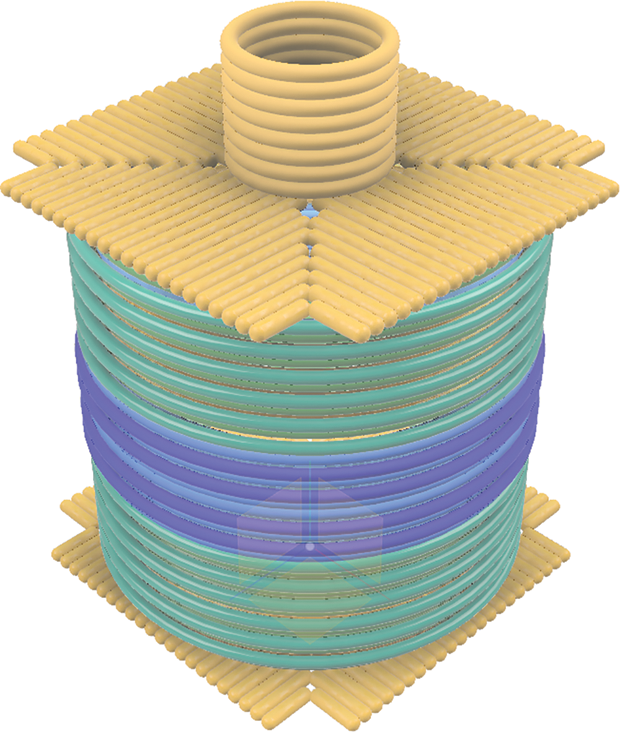
Currently, "we are developing a cancer vaccine using Deoxyribonucleic acid origami," she says. "The manner the payloads—for example, tumor antigen and adjuvant—are bundled on the origami can create molecular signals for their receptor targets. When the device reaches the antigen-presenting cells, it enters and releases the payloads to the cells [to ultimately] generate a robust anticancer immune response."
This technique lets i customize shapes and functions to load different types of things onto the Deoxyribonucleic acid nanorobots, such as antigen and adjuvant or other ligands for cells to boost a patient'due south immune response, or a tracking or imaging compound to more efficiently find tumors.
While this organic nanobot approach is promising for nanomedicine, information technology faces similar limitations of other nanomedicine techniques, particularly cost, control, and figuring out how to translate it effectively for cancer immunology.
"Generally, the experts doing DNA origami inquiry are in the synthetic biological science area rather than cell biological science and medical [areas]. Others in nanotech are coming from the engineering side. And clinicians typically don't know a lot about these technologies," says Zeng. "I'm hoping to bridge that gap past studying both the technology and clinical needs."
1 consideration for clinical applications is the possibility of unintended toxic side effects. An advantage to the organic approach is that the toxicity of this material is very low, according to Zeng. "In one case you deliver the organic nanobot into the torso, after it carries out its role, it could be digested by your cells like any other cellular debris," she says.
Others are as well accelerating research into nanorobotics for medicine, and closing in on clinical trials. Debabrata (Dev) Mukhopadhyay, PhD, director of the Mayo Clinic'due south nanotechnology lab based in Florida, is close to finalizing phase-1 clinical trials for a nanotechnology-based drug commitment organization targeting aggressive tumors.
"In addition to drug delivery, we aim to utilise nanoparticles to monitor tumor therapeutic outcome in existent fourth dimension," says Mukhopadhyay, who points out that often when people are given chemotherapy, months go by before it'due south articulate whether the therapeutic drug is having an issue.
The lab also focuses on developing, testing, and applying nanorobotics to other medical areas, especially cardiovascular disease (delivering nanogel to repair arteries) and early-stage dementia (such as a biomarker nanoimaging system), as well as other immune disorders.
Mukhopadhyay, who draws his inspiration from the decades of interest in using materials like silver and aureate for antimicrobial furnishings, cautions that any nanomedicine will demand to be thoroughly tested for an allowed reaction. Some of his work focuses on nanodiamonds, i of the lesser immunoreactive nanoparticles, which other researchers (such as Stanford professor Steven Chu) are investigating for a range of uses, including biomedical imaging.
Research into using nanorobotics and materials for cancer has been picking up speed in the last few years, and work likewise done at the Mayo Clinic has made progress in targeting specific cancer. Enquiry led by Prof. Betty Kim showed a proof- of-concept that nanomaterials coated with antibodies to target a type of chest cancer receptor combined with molecules that activate the immune organization, acting similar flags on the cancer to assistance immune cells spot which tumorous cells to attack [iv]. And in an advance in identifying cancer early, Prof. Shan Wang at the Stanford Heart for Cancer Nanotechnology Excellence detailed an approach to employ sensor engineering and clusters of magnetic nanoparticles to adhere to DNA and flag cancerous cells [5].
Despite these successes, it volition be a while earlier we meet the fully realized nanorobotics in use.
"Efficacy actually needs to be proved in nanomedicine: Fifty-fifty with a passive dispersal of nanoparticles, there needs to be clear evidence that information technology's more than efficient than the existing methods. For the near part, the field as a whole is still in a proof-of-concept stage rather than a clinical-trial phase," says Fischer. "There are encouraging scenarios where ane can testify that aspects piece of work and maybe the dream of targeted, autonomous commitment systems can be realized, but it's certainly a decade abroad at least."
References
- Z. Wu et al., "A swarm of slippery micropropellers penetrates the vitreous body of the eye," Sci. Adv., vol. 4, no. 11, Nov. 2018, Fine art. no. eaat4388. Doi: 10.1126/sciadv.aat4388.
- O. Felfoul et al., "Magneto-aerotactic bacteria deliver drug-containing nanoliposomes to tumour hypoxic regions," Nature Nanotechnol., vol. 11, no. 11, pp. 941–947, Nov. 2016. Doi: 10.1038/ nnano.2016.137.
- South. Betal et al., "Core-shell magnetoelectric nanorobot—A remotely controlled probe for targeted cell manipulation," Sci. Rep., vol. 8, 2018, Fine art. no. 1755.
- H. Yuan et al., "Multivalent bi-specific nanobioconjugate engager for targeted cancer immunotherapy," Nature Nanotechnol., vol. 12, no. 8, pp. 763–769, Aug. 2017. Doi: 10.1038/nnano.2017.69.
- S. Ten. Wang and C. Ooi, "Marrying nanomagnetics with RNA sequencing of single cancer cells," in Proc. IEEE Int. Magn. Conf. (INTERMAG), Apr. 2018.
Source: https://www.embs.org/pulse/articles/the-state-of-nanorobotics-in-medicine/
0 Response to "State of the Art in Electromagnetic Therapeutics Soft Tissue Applications Pilla"
Post a Comment