Artlabeling Activity Frequency of Stinulation and Muscle Fiber Tension Mastering Ap
Which of the following is CORRECTLY paired?
A. cardiac musculus: nonstriated
B. smooth muscle: striated
C. skeletal muscle: voluntary control
D. cardiac muscle: voluntary control
C. skeletal muscle: voluntary control
What causes the release of calcium from the terminal cisternae of the sarcoplasmic reticulum inside a muscle jail cell?
A. inflow of an action potential
The binding of calcium to which molecule causes the myosin binding sites to be exposed?
B. troponin
A myosin head binds to which molecule to grade a cross bridge?
B. actin
What causes the myosin head to disconnect from actin?
A. binding of ATP
What energizes the power stroke?
A. hydrolysis of ATP
In a neuromuscular junction, synaptic vesicles in the motor neuron contain which neurotransmitter?
C. acetylcholine (ACh)
When an action potential arrives at the axon terminal of a motor neuron, which ion channels open?
A. voltage-gated calcium channels
What ways of membrane ship is used to release the neurotransmitter into the synaptic cleft?
B. exocytosis
The binding of the neurotransmitter to receptors on the motor terminate plate causes which of the following to occur?
A. Bounden of the neurotransmitter causes chemically gated sodium channels to open in the motor finish plate.
How is acetylcholine (ACh) removed from the synaptic cleft?
B. acetylcholinesterase (Anguish; an enzyme)
The action potential on the muscle prison cell leads to contraction due to the release of calcium ions. Where are calcium ions stored in the muscle cell?
C. concluding cisternae of the sarcoplasmic reticulum
Excitation-wrinkle coupling is a series of events that occur subsequently the events of the
neuromuscular junction have transpired. The term excitation refers to which step in the process?
A. Excitation refers to the shape alter that occurs in voltage-sensitive proteins in the sarcolemma.
B. Excitation refers to the release of calcium ions from the sarcoplasmic reticulum.
C. Excitation, in this instance, refers to the propagation of action potentials along the sarcolemma.
D. Excitation refers to the propagation of action potentials along the axon of a motor neuron.
D. Excitation refers to the propagation of action potentials along the axon of a motor neuron.
Excitation of the sarcolemma is coupled or linked to the contraction of a skeletal muscle fiber. What specific event initiates the contraction?
C. Calcium release from the sarcoplasmic reticulum initiates the contraction.
A triad is composed of a T-tubule and two adjacent terminal cisternae of the sarcoplasmic reticulum. How are these components connected?
C. A series of proteins that command calcium release.
What is name given to the regularly spaced infoldings of the sarcolemma?
A. transverse or T tubules
Which of the following is most directly responsible for the coupling of excitation to contraction of skeletal muscle fibers?
A. Calcium ions.
B. Acetylcholine.
C. Activeness potentials.
D. Sodium ions.
A. Calcium ions.
What is the human relationship between the number of motor neurons recruited and the number of skeletal musculus fibers innervated?
B. Typically, hundreds of skeletal muscle fibers are innervated by a single motor neuron.
Excitation-contraction coupling includes all EXCEPT which of the following events?
A. propagation of an action potential along the sarcolemma and downwards T tubules
B. binding of calcium ions to troponin, which removes the blocking action of tropomyosin
C. release of acetylcholine from axon terminals at the neuromuscular junction
D. release of calcium ions from the concluding cisterns
C. release of acetylcholine from axon terminals at the neuromuscular junction
What is a cross bridge cycle?
A. It is the cycle by which the sarcolemma is repeatedly depolarized and repolarized.
B. It is a cycle of repeated stimuli resulting in summation of muscle twitches.
C. It is the cycle in which motor units are recruited from small to large, in gild to produce gradual increases in force.
D. Information technology is the bicycle in which an energized myosin caput binds to actin and performs a power stroke, so binds to ATP in order to detach and re-energize.
D. It is the wheel in which an energized myosin head binds to actin and performs a ability stroke, then binds to ATP in order to detach and re-energize.
Muscle tissue does Non ________.
A. produce movement
B. generate heat
C. produce claret cells
D. maintain posture
E. stabilize joints
C. produce blood cells
Which blazon of muscle CANNOT contract without being stimulated by the nervous arrangement?
A. skeletal
B. cardiac
C. smooth
D. visceral
A. skeletal
Which muscle characteristic describes the power of muscle to respond to a stimulus?
A. excitability
B. contractility
C. extensibility
D. elasticity
A. excitability
Action potential propagation in a skeletal muscle fiber ceases when acetylcholine is removed from the synaptic cleft. Which of the following mechanisms ensures a rapid
and efficient removal of acetylcholine?
C. Acetylcholine is degraded by acetylcholinesterase.
The neuromuscular junction is a well-studied instance of a chemical synapse. Which of the post-obit statements describes a critical event that occurs at the neuromuscular junction?
D. When the action potential reaches the end of the axon terminal, voltage-gated sodium channels open and sodium ions lengthened into the terminal.
B. Acetylcholine is released by axon terminals of the motor neuron.
Action potentials travel the length of the axons of motor neurons to the axon terminals. These motor neurons __________.
C. extend from the brain or spinal string to the sarcolemma of a skeletal muscle fiber
Calcium entry into the axon final triggers which of the following events?
A. Synaptic vesicles fuse to the plasma membrane of the axon concluding and release acetylcholine.
Acetylcholine binds to its receptor in the sarcolemma and triggers __________.
C. the opening of ligand-gated cation channels
Sodium and potassium ions do non diffuse in equal numbers through ligand-gated cation channels. Why?
A. The within surface of the sarcolemma is negatively charged compared to the outside surface. Sodium ions diffuse inwards along favorable chemical and electrical gradients.
B. The within surface of the sarcolemma is negatively charged compared to
the exterior surface. Potassium ions diffuse inwards along favorable chemic and electrical gradients.
C. The exterior surface of the sarcolemma is negatively charged compared to the inside surface. Sodium ions diffuse outward along favorable chemic and electrical gradients.
D. The outside surface of the sarcolemma is negatively charged compared to the inside surface. Potassium ions diffuse outward forth favorable chemical and electrical gradients.
A. The inside surface of the sarcolemma is negatively charged compared to the outside surface. Sodium ions diffuse inward forth favorable chemical and electrical gradients.
The cross bridge cycle is a series of molecular events that occur afterward excitation of the sarcolemma. What is a cross bridge?
B. A myosin head bound to actin
What construction is the functional unit of contraction in a skeletal muscle fiber?
A. The sarcomere
Calcium ions couple excitation of a skeletal muscle fiber to wrinkle of the fiber. Where are calcium ions stored inside the cobweb?
B. Calcium ions are stored in the sarcoplasmic reticulum.
Afterwards a power stroke, the myosin head must disassemble from actin before another power stroke tin occur. What causes cantankerous bridge disengagement?
D. ATP binds to the myosin head.
How does the myosin head obtain the energy required for activation?
D. The energy comes from the hydrolysis of ATP.
What specific event triggers the uncovering of the myosin binding site on actin?
D. Calcium ions bind to troponin and change its shape.
When does cross bridge cycling terminate?
A. Cross bridge cycling ends when calcium release channels in the sarcoplasmic reticulum open.
B. Cantankerous span cycling ends when calcium ions are passively transported dorsum into the sarcoplasmic reticulum.
C. Cross bridge cycling ends when sufficient calcium has been actively transported back into the sarcoplasmic reticulum to allow calcium to unbind from troponin.
D. Cross bridge cycling ends when ATP binds to the myosin caput.
C. Cross span cycling ends when sufficient calcium has been actively transported dorsum into the sarcoplasmic reticulum to permit calcium to unbind from troponin.
In the figure above, which structure corresponds to a single skeletal muscle prison cell?
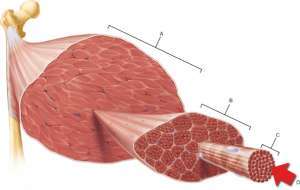
D. C
The connective tissue that covers structure A is continuous with which of the following?
A. tendon
B. sarcolemma
C. endomysium
D. ligament
A. tendon
Which structure corresponds to a single fascicle?
A. A
B. B
C. C
D. D
B. B
Which of the following is the smallest structural unit in which the distinctive striated bands characteristic of skeletal muscle are observed?
A. D
The smallest contractile unit within skeletal muscle would correspond to the altitude betwixt which two points in the effigy?
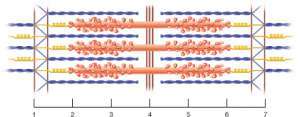
A. 3 and five
B. one and seven
C. two and half dozen
D. one and iii
B. 1 and 7
Between which two points would in that location be substantial amounts of both the proteins actin and myosin?
A. 2 and 3
B. 1 and 2
C. 3 and five
D. None of the listed responses is correct.
A. 2 and 3
The region between which ii points corresponds to the I band?
A. 3 and five
B. 2 and 5
C. two and 3
D. None of the listed responses is correct.
D. None of the listed responses is correct.
What cellular event is indicated by A?
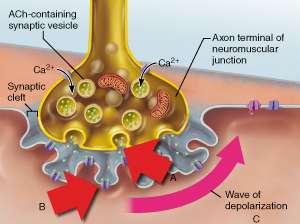
A. facilitated diffusion
B. active send
C. endocytosis
D. exocytosis
D. exocytosis
What event directly triggers the release of neurotransmitter shown in A?
A. diffusion of Thousand+ into the axonal terminus
B. diffusion of Na+ out of the axonal terminus
C. diffusion of Ca2+ into the axonal terminus
D. diffusion of Na+ into the axonal terminus
C. improvidence of Ca2+ into the axonal terminus
What specific neurotransmitter is released from the axonal terminus as shown in A?
A. myosin
B. calcium
C. actin
D. acetylcholine
D. acetylcholine
Which statement accurately describes the event indicated past B?
A. Diffusion of Ca2+ into the muscle cobweb triggers the diffusion of acetylcholine out of the musculus fiber.
B. Binding of acetylcholine to a receptor triggers the opening of an ion aqueduct.
C. Diffusion of acetylcholine into the muscle cobweb triggers the opening of an ion aqueduct.
D. Diffusion of acetylcholine into the muscle fiber triggers the diffusion of Ca2+ out of the muscle fiber.
B. Bounden of acetylcholine to a receptor triggers the opening of an ion channel.
Which event is virtually pregnant in initiating the "wave of depolarization" shown in outcome C?
A. diffusion of Na+ into the muscle cobweb
B. diffusion of Thousand+ out of the musculus fiber
C. diffusion of acetylcholine down the length of the musculus fiber
D. diffusion of acetylcholine into the muscle fiber
A. diffusion of Na+ into the muscle fiber
The protein actin is indicated by which alphabetic character?
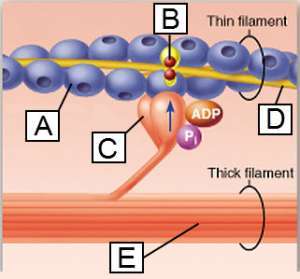
A. A
Which protein is indicated by E?
A. actin
B. troponin
C. tropomyosin
D. myosin
D. myosin
The molecular interaction described equally a "cantankerous span" involves the binding of which two of the messages below?
A. B and D
B. A and C
C. A and B
D. A and D
B. A and C
Which lettered protein functions equally a motor protein?
A. C
The protein troponin is shown in this effigy to be bound to which substance?
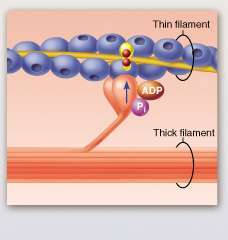
A. calcium ion
In which phase in the figure would the internet movement of Ca2+ into the sarcoplasmic reticulum (SR) be greatest?
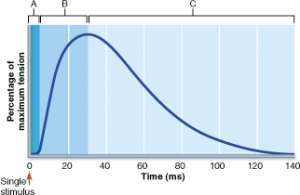
C. C
Which of the following is true concerning the anatomy of a skeletal musculus fiber?
B. Myofibrils contain thick and thin filaments.
The calcium that initiates skeletal muscle contraction is released from what structure(s)?
B. terminal cisternae
Which of the following are composed of myosin?
A. thick filaments
In musculus fibers, which regulatory poly peptide blocks the attachment of myosin heads to actin?
B. tropomyosin
What event most straight triggers the release of calcium from the terminal cisternae?
D. activity potential propagating downwards the T tubule
How practice calcium ions initiate contraction in skeletal muscle fibers?
C. Calcium ions demark to troponin, changing troponin'southward shape.
Which of the following all-time describes the events of "excitation" in "excitation-contraction coupling"?
B. propagation of the action potential along the sarcolemma
Which of the following all-time describes the events of "contraction" in "excitation-contraction coupling"?
B. cross bridge formation
Isometric contraction leads to movement of a load. True or False
Faux
Thick myofilaments are made of ________.
A. myosin
B. tropomyosin
C. troponin
D. actin
A. myosin
Which pathway for regenerating ATP provides the majority of the energy used for muscle action during xxx minutes of light to moderate exercise?
A. aerobic respiration
B. use of stored ATP
C. anaerobic glycolysis
D. direct phosphorylation of ADP by creatine phosphate
A. aerobic respiration
The type of muscle constitute in the walls of most hollow organs is ________.
A. skeletal muscle
B. cardiac muscle
C. unitary shine muscle
D. multi unit polish musculus
C. unitary smooth muscle
A muscle that is lengthening while information technology produces tension is performing a(an) ________ contraction.
A. isometric
B. maximal
C. eccentric
D. concentric
C. eccentric
The first step toward generating a skeletal musculus contraction is ________.
A. bounden of the myosin heads to actin
B. stimulation of the muscle by a nerve ending
C. binding of ATP to the myosin heads
D. a rise in intracellular Ca2+ levels
B. stimulation of the muscle by a nervus catastrophe
Which muscle fiber blazon is best suited for endurance activities, such as long-distance jogging?
A. fast oxidative fibers
B. fast glycolytic fibers
C. slow glycolytic fibers
D. boring oxidative fibers
D. ho-hum oxidative fibers
What is the type of chemic reaction used to rebuild ADP into ATP?
A. aridity synthesis
Which of the following processes produces molecules of ATP and has two pyruvic acrid molecules as end products?
C. glycolysis
Which of the post-obit processes produces 36 ATP?
A. Krebs cycle and oxidative phosphorylation
The "balance and recovery" period, where the muscle restores depleted reserves, includes all of the following processes EXCEPT __________.
B. Pyruvic acid is converted dorsum to lactic acrid.
Which blazon of musculus fiber has a large quantity of glycogen and mainly uses glycolysis to synthesize ATP?
A. white fast twitch fibers
B. ruby slow twitch fibers
A. white fast twitch fibers
In which phase of the muscle twitch shown in the to a higher place figure would the maximum amount of ATP exist consumed by myosin caput groups?
A. B
When muscle cells suspension downwards glucose to generate ATP under oxygen deficient weather condition, they will form ________.
A. glucose
B. fatty acids
C. lactic acrid
D. glycogen
C. lactic acid
The strength of a muscle contraction is NOT affected by __________.
A. the number of muscle fibers stimulated
B. the frequency of the stimulation
C. the size of the muscle fibers stimulated
D. the caste of muscle stretch
E. the amount of ATP stored in the musculus cells
E. the amount of ATP stored in the musculus cells
Cantankerous bridge formation between myosin heads and actin molecules is caused by the elevation of calcium ion concentration in the cytosol. During rigor mortis, this elevation of calcium ion concentration in the cytosol is permanent because ________.
A. mitochondria stop producing ATP molecules required by the sarcoplasmic reticulum's calcium ion pumps
B. troponin molecules bind irreversibly to calcium ions to prevent them from beingness removed from the cytosol
C. tropomyosin molecules bind irreversibly to calcium ions to prevent them from being removed from the cytosol
D. acetylcholine continues to stimulate the release of calcium ions from the sarcoplasmic reticulum
A. mitochondria stop producing ATP molecules required by the sarcoplasmic reticulum's calcium ion pumps
The sliding filament model of wrinkle states that ________.
A. during contraction the thin myofilaments slide past the thick myofilaments so that calcium ions can be released from the sarcoplasmic reticulum
B. during contraction the thin myofilaments slide past the thick myofilaments so that the actin and myosin myofilaments no longer overlap
C. during wrinkle the thin myofilaments slide past T tubules and then that the Z discs are overlapping
D. during contraction the thin myofilaments slide past the thick myofilaments so that the actin and myosin myofilaments overlap to a greater degree
D. during contraction the sparse myofilaments slide past the thick myofilaments and then that the actin and myosin myofilaments overlap to a greater caste
The distance between Z discs ________ during muscle contraction.
A. increases
B. decreases
C. decreases and and then increases
D. stays the same
B. decreases
Which poly peptide inhibits interaction betwixt actin and myosin to prevent skeletal muscle wrinkle; and which ions remove the
inhibition?
A. tropomyosin; calcium ions
B. myosin; sodium ions
C. troponin; sodium ions
D. actin; calcium ions
A. tropomyosin; calcium ions
The response of a motor unit to a single action potential of its motor neuron is called ________.
A. a muscle twitch
B. recruitment
C. moving ridge summation
D. a tetanic contraction
A. a muscle twitch
What result would be expected if an boosted stimulus, equal in intensity to the showtime, were to be applied to the muscle at the 60 millisecond (ms) time indicate?
A. Tension would increase to the aforementioned maximum force measured at the starting time of phase C.
B. The muscle would apace return to the fully relaxed state of minimum tension.
C. The muscle would increase in tension to a level greater than that measured at the showtime of phase C.
D. The tension exerted by the muscle would continue to decrease, but at a significantly slower rate than observed without the 2d stimulus.
C. The musculus would increment in tension to a level greater than that measured at the outset of phase C.
Slow oxidative musculus fibers are best suited for ________.
A. running a marathon
B. running a 100-yard dash
C. hitting a baseball
D. lifting heavy weights at the gym
A. running a marathon
Choose the False statement.
A. Skeletal muscle cells have glycosomes.
B. Skeletal muscle cells utilise creatine phosphate instead of ATP to practise piece of work.
C. Skeletal muscle cells have T tubules.
D. Skeletal muscle cells are multinucleated.
E. Skeletal musculus cells contain myoglobin.
B. Skeletal muscle cells utilise creatine phosphate instead of ATP to exercise work.
What special feature of smoothen muscle allows it to stretch without immediately resulting in a strong contraction?
A. stress-relaxation response
B. low free energy requirements
C. wearisome, prolonged contractile activity
D. smooth musculus tone
A. stress-relaxation response
The smallest contractile unit of measurement of a muscle fiber is ________.
A. the rubberband filament
B. troponin
C. the sarcomere
D. the myofilament
C. the sarcomere
Cardiac muscle makes nearly of its ATP via anaerobic pathways. True or False
False; aerobic
Binding of calcium to calmodulin is a pace in excitation-contraction coupling of ________ cells.
A. polish muscle
B. skeletal muscle
C. cardiac muscle
D. cardiac and visceral smooth muscle
A. smooth muscle
Smoothen muscles are able to regenerate throughout life. True or False
Truthful
Which of the following is TRUE?
A. Skeletal muscle fibers tend to be shorter than shine muscle fibers.
B. Skeletal muscle fibers contain sarcomeres; smooth musculus fibers do not.
C. Skeletal muscle cells have ane nucleus, but smoothen muscle cells are multinucleated.
D. Skeletal muscle lacks the fibroid connective tissue sheaths that are plant in shine musculus.
B. Skeletal musculus fibers contain sarcomeres; smooth muscle fibers do non.
Which of the following factors influence the velocity and elapsing of musculus contraction?
A. length of muscle fibers activated
B. frequency of stimulation
C. load placed on the muscle
D. muscle cobweb size
C. load placed on the muscle
The major role of the sarcoplasmic reticulum is to regulate ________.
A. intracellular levels of Na+
B. extracellular levels of Ca2+
C. extracellular levels of Na+
D. intracellular levels of Ca2+
D. intracellular levels of Ca2+
Source: https://freezingblue.com/flashcards/220093/preview/chapter-9-muscles-and-muscles-tissue-mastering-a-p
0 Response to "Artlabeling Activity Frequency of Stinulation and Muscle Fiber Tension Mastering Ap"
Post a Comment